- Home
- /
- Article

Thanks for your feedback.


Enable AI Assistant features in Control Hub for Webex Contact Center
 In this article
 Feedback?
This article guides Contact Center administrators on how to enable Cisco AI Assistant features using Control Hub, included in the AI Assistant add-on for Contact Center.
What is Cisco AI Assistant?
Webex Contact Centre AI-powered features are designed to help agents, supervisors, analysts, and administrators work more efficiently, improve service quality, support employee well-being, and make better decisions using interaction insights.
The Cisco AI Assistant, integrated into Webex Contact Center, provides agents, supervisors, and analysts with user-friendly AI features. These features are designed to help agents and supervisors work more efficiently, support employee well-being, and improve overall service quality.
To use these AI-powered features, administrators must enable them through Control Hub.
Administrators enable key functionalities such as AI-generated summaries, including Call Drop Summary and AI Agent Transfer Summary, which help agents work more efficiently. Additionally, Automated Wellness Breaks are available to support agent well-being, ensuring high-quality service delivery. Administrators can enable Auto CSAT, providing supervisors and analysts with insights into customer satisfaction, facilitating data-driven decisions to improve overall service quality in the contact center. Administrators can also enable Real-time Transcriptions, allowing agents to follow live conversations through text, improving accessibility, compliance, and interaction insights.
Find detailed information on AI Assistant usage and billing in the License consumption and reporting guide, under AI Assistant Usage section.
Prerequisites
-
Customers need to purchase the new AI Assistant add-on SKU (A-FLEX-AI-ASST).
-
Users need the AI Assistant included in their user profile access. To provide this access, configure the setting as part of the Desktop Experience within their profile. See how to manage user profiles, including their Desktop Experience, in the Manage user profiles of contact center users article.
The AI Features section includes features that can be configured at different levels:
-
Organization level—Enables the feature for the organization and makes additional configuration available where supported.
-
Queue level—Applies the feature only to selected queues or to all queues.
-
Agent level—Applies the feature to all agents or to selected agents.
List of AI Assistant features
Once you have purchased the AI Assistant and / or AI Quality Management Add-on, you can enable the following features for your organization on Control Hub:
|
Feature |
Description |
When to use |
How to use |
Included in |
Enablement scope |
|---|---|---|---|---|---|
|
AI Agent transfer summary |
If an AI agent requires assistance from a human agent, a summary of the conversation with the AI agent is presented when the call is transferred. |
To quickly understand the key details from the AI agent call, ensuring the customer does not need to repeat themselves. |
AI Assistant |
Queue | |
|
Call drop summary |
If a call drops, the AI Assistant generates a summary for the next agent when the customer calls back, ensuring the conversation continues seamlessly and without repetition. |
To quickly understand the previous conversation so the customer does not need to repeat themselves. |
AI Assistant |
Queue | |
|
Real-time transcriptions* |
Provides live transcription of customer-agent conversations, enabling agents and supervisors to follow conversations in real time. |
To improve accessibility, provide live interaction insights, and assist with compliance and quality monitoring. |
Both |
Queue | |
|
Real-time Assist |
Continuously analyzes live conversations, including voice and digital interactions, to understand context and customer intent and provide instant recommendations on what to say or do. |
To support agents with in-the-moment guidance during active interactions and improve communication efficiency, agent performance, and customer satisfaction. |
Enable Real-Time Assist in Control Hub and apply the configuration to the relevant agent experience where supported. |
AI Assistant |
Agent |
|
Mid-call transfer/consult summaries |
Provides an AI-generated summary of the conversation so far when an agent consults or transfers a call, reducing manual note-taking and helping important details carry forward. |
To help the next agent or consulted party quickly understand the current interaction context during a transfer or consult. |
AI Assistant |
Queue | |
|
Post-call summaries (Wrap-up summaries) |
Creates an AI-generated summary automatically after the customer disconnects, capturing the reason for the call, actions taken, status, and follow-up items. |
To reduce wrap-up effort and keep a concise record of the completed interaction for follow-up and review. |
AI Assistant |
Queue | |
|
Agent wellbeing |
Smart reminders to take wellness breaks between calls, helping agents avoid burnout and maintain performance. |
During long or intense stretches of calls, wellness breaks are offered to help agents stay refreshed and focused. |
AI Assistant |
Agent | |
|
Sentiment analysis* |
Calculates customer sentiment for completed interactions and classifies the result as positive, neutral, or negative. |
To identify interactions that may need review and add more context to agent performance and customer experience discussions. |
Enable sentiment analysis for the required queues in Control Hub. |
Both |
Queue |
|
Auto CSAT* |
Auto CSAT scores help predict customer satisfaction by analyzing conversations between agents and callers. |
To provide AI-based insight into customer satisfaction, helping organizations improve service quality and make data-driven decisions. |
Both |
Agent | |
|
Topic Analytics |
Uses historical data to identify the primary reasons customers contact the center and helps teams analyze those topics for proactive actions such as training, FAQ updates, or process changes. |
To understand why customers are contacting the center and identify recurring topics, trends, and improvement opportunities. |
AI Assistant |
|
See this link to know more about the languages supported by AI Assistant features. If your organization purchased the AI Assistant and AI Quality Management bundle, AI Quality Management features are also available for enablement on the same Control Hub page. See the link to enable AI Quality Management features in Control Hub.
How to access AI Assistant Features in Control Hub
- Sign in to Control Hub and navigate to .
- Open AI Features under Desktop Experience in the navigation pane.
How to enable AI-generated summaries feature
Before you begin
-
Enable call recording to facilitate post-call processing, which is necessary to produce AI-generated summaries.
-
Ensure that your agents have enabled notifications on their Webex Contact Center Agent Desktop, as this is essential for using the AI Assistant features.
Administrators can enable the AI-generated summaries feature in the AI Features area in Control Hub to enhance customer satisfaction and increase agent efficiency. Once enabled, the AI Assistant generates summaries at critical points in interactions, helping agents save time and prevent customers from having to repeat information.
Enable these features to allow agents to access the following capabilities within the AI Assistant widget on the Agent Desktop:
Call drop summary
Customers often feel frustrated, especially after a dropped call. Enable Call drop summaries to help agents continue from where the previous call ended, reducing frustration, decreasing handling time, and improving efficiency.
The dropped call summary presents information about recent calls to agents. Cisco AI Assistant uses ANI as a parameter to determine when a call drop summary should be presented to an agent. We recommend training agents on verification procedures to prevent accidentally sharing customer information with the wrong person.
Virtual Agent Transfer Summary
More customers are turning to AI agents for issue resolution, but there are times when human assistance is needed. By enabling Virtual agent transfer summaries, the AI Assistant provides human agents with a summary of the interaction and the reason for escalation, ensuring they are quickly up to speed and ready to assist effectively.
For detailed information on the ethical and technical considerations of this feature, see AI Transparency Technical Note.
You can enable generated summary features in Control Hub by following these steps:
-
Sign in to Control Hub and navigate to .
-
Go to AI Features in the navigation pane.
-
In the Generated Summaries section, toggle the Generated summaries switch and turn on the following:
-
Click:
-
Mid-call summaries
-
Call drop summaries
-
Virtual agent transfer summaries
-
Wrap-up summaries
-
-
Use the Queues section to specify which queues can access and generate summaries.
- All queues—Select this option to enable AI-generated summaries for all queues.
- Individual queues—Select this option to limit AI-generated summaries to specific queues. If you select this option, click Manage queues and select the queues you want to include from the dialog box.
-
Click Save.
How to enable real-time transcriptions
You can enable real-time transcriptions in Control Hub by following these steps:
- Sign in to Control Hub and navigate to .
- Open AI Features in the navigation pane.
- Turn on Real-time transcriptions from queue level settings.
- Choose whether the feature applies to all queues or select the necessary queue from Queues tab and turn on the feature.
- Click Manage flows to navigate to the Flow Designer and identify the call flows that are linked to the queues where transcription is required.
- To activate real-time transcriptions:
-
For specific queues, see Enabling media streaming for specific queues article to configure media streaming within the Flow Designer, using conditional logic as described.
For all queues: In the Flow Designer, for your relevant call flow(s), navigate to the event flow canvas and add the Start Media Stream activity directly after the
AgentAnsweredevent. This action starts transcription for every call routed through this flow, bypassing the need for conditional logic used for specific queues. After adding the activity, ensure you Save and Publish the updated flow(s) to apply the changes.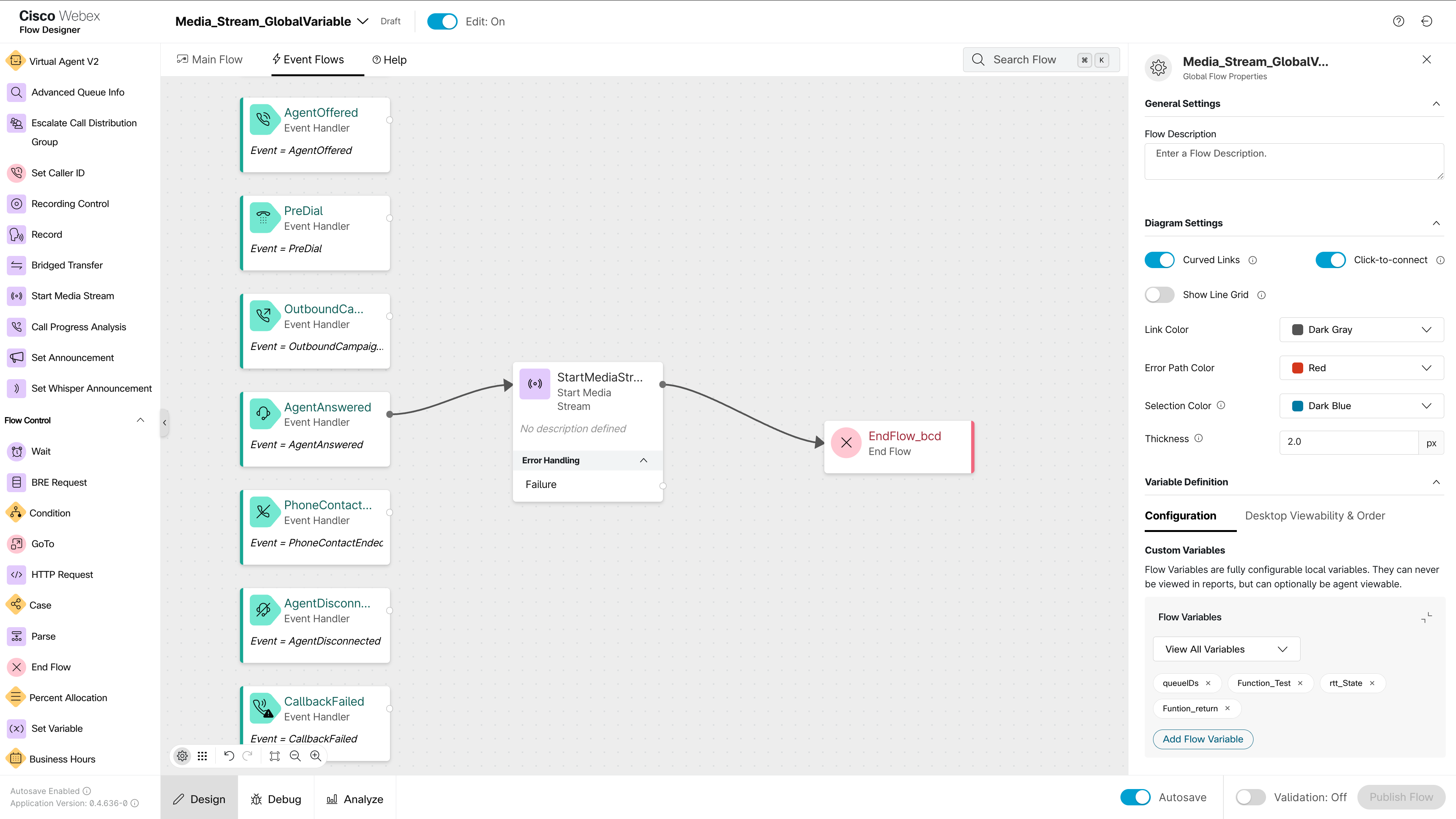
-
Media streaming allows audio streams to be duplicated and processed for real-time transcription, ensuring that audio from customer interactions is forked, enabling the transcription engine to process and convert spoken words into text.
Real-time transcription is automatically enabled with the Global Desktop Layout. If you are using a Custom Layout and want to enable real-time transcription, you need to ensure that the RT_TRANSCRIPT visibility is properly configured in the panel section of your layout for all relevant personas—agent, supervisor, and agent-supervisor. For detailed instructions, refer to the Enable real-time transcription in custom layouts section.
Update to desktop layouts
The AI Assistant is available automatically if you are using the Global Desktop Layout, so no additional action is needed.
If you are using a Custom Layout to personalize Agent desktops, you will need to make the following edit to enable the AI Assistant:
-
Locate the advancedHeader: In your custom layout JSON configuration, find the
areasection for each relevant persona (agent, supervisor, agent-supervisor). Inside theareasection, locate the advancedHeader array. -
Add the AI Assistant component: Add the following JSON snippet as a new, separate item within the advancedHeader array:
{"comp": "ai-assistant"}
For a comprehensive guide to creating and modifying custom desktop layouts, refer to the Create custom desktop layout article. For more details on desktop layouts, refer to the Manage desktop layouts article.
Enable real-time transcription in custom layouts
If you are using a custom layout and want to enable the real-time transcription feature, you need to ensure that the RT_TRANSCRIPT visibility is properly configured in your layout JSON.
Locate the panel section: In your custom layout JSON configuration, find the area section for each relevant persona (agent, supervisor, agent-supervisor). Inside the area section, locate the panel section.
Verify RT_TRANSCRIPT configuration: Within the panel section, ensure that the following code snippet (or a similar configuration for real-time transcription) is present:
{
"comp": "md-tab",
"attributes": {
"slot": "tab",
"class": "widget-pane-tab"
},
"children": [
{
"comp": "slot",
"attributes": {
                  "name":
                "RT_TRANSCRIPT_TAB"
}
}
],
"visibility": "RT_TRANSCRIPT"
},
{
"comp": "md-tab-panel",
"slot": "panel",
"class": "widget-pane"
},
"children": [
{
"comp": "slot",
"attributes": {
"name": "RT_TRANSCRIPT"
}
}
],
"visibility": "RT_TRANSCRIPT"
},
Ensure RT_TRANSCRIPT visibility is enabled: The key is the "visibility": "RT_TRANSCRIPT" attribute. Make sure this attribute is present and that the value RT_TRANSCRIPT corresponds to a defined visibility setting in your system. If the visibility attribute is missing or set to a different value, the real-time transcription tab will not be displayed.
Save and apply: Save the modified custom layout JSON file and apply it to the relevant users or profiles in the Control Hub.
How to enable Real-Time Assist
Administrators can enable and manage the Real-Time Assist feature for agents, helping improve communication efficiency, agent performance, and customer satisfaction.
For more details, see Enable Real-Time Assist for your Webex Contact Center.
How to enable agent burnout detection and wellness breaks
Before you begin
-
Enable call recording to facilitate post-call processing, which is necessary to produce AI-generated summaries.
-
Ensure that your agents have enabled notifications on their Webex Contact Center Agent Desktop, as this is essential for using the AI Assistant features.
Administrators can enable the Agent well being feature in the AI Features area in Control Hub to support agent burnout detection and wellness break reminders. Once enabled, the system monitors burnout indicators and can provide wellness reminders to help agents stay refreshed and focused.
The AI Assistant is automatically enabled with the Global Desktop Layout. If you're using a Custom Layout, update your layout to include AI-assistant for all relevant personas—agent, supervisor, and agent-supervisor. For detailed instructions, refer to Update to Desktop Layouts.
You can enable agent burnout detection and wellness breaks in Control Hub by following these steps:
-
Sign in to Control Hub and navigate to .
-
Open AI Features in the navigation pane.
-
In the Agent level settings section, go to Agent well being and turn on the feature.
-
Select apply to all agents if you wish to enable the feature to all agents.
-
If you wish to enable it to selective agents, go to Agents tab and select the list of agents. Turn on the feature on the next page.
-
Click Save.
How to enable Auto CSAT feature
Before you begin
-
Enable call recording to facilitate post-call processing, which is necessary to produce Auto CSAT predictions.
Administrators can enable the Auto CSAT feature in the AI Features area in Control Hub to predict customer satisfaction for interactions in the contact center. Once enabled, Auto CSAT provides AI-based customer satisfaction scores that supervisors and analysts can use to review service quality and identify trends.
You can enable Auto CSAT in Control Hub by following these steps:
-
Sign in to Control Hub and navigate to .
-
Open AI Features in the navigation pane.
-
Turn on Auto CSAT from Queue level settings section and select all queues if you wish to enable the feature to all queues.
-
Select Experience Management to choose the CSAT questions from your surveys to train the Auto CSAT model or Global Variable to choose the global variable used to store survey responses.
-
If you wish to enable it to selective queues, select the list of queues from ‘queues’ tab , toggle on generate summaries on the next page and select the summary types.
-
Click Save.
Auto CSAT configuration is only available for administrators and can be managed through user profiles. For detailed information on the model we use to predict Auto CSAT, the data sources we use for training, the frequency of training and evaluation, and more, see AI Transparency Technical Note.
How to enable Sentiment Analysis
Before you begin
- Make sure real-time transcription is enabled for the queues where you want to use Sentiment Analysis.
- Make sure the related flows are updated so transcription starts for the selected queues.
Administrators can enable Sentiment analysis in the AI Features area in Control Hub to classify customer sentiment for completed interactions. Once enabled, the system classifies sentiment as positive, neutral, or negative, helping supervisors identify interactions that may need review.
You can enable Sentiment Analysis in Control Hub by following these steps:
- Sign in to Control Hub and navigate to .
- Open AI Features in the navigation pane.
- In the Queue level settings section, turn on Sentiment analysis.
-
Select apply to all queues if you wish to enable AI-generated summaries for all queues.
-
If you wish to enable it to selective queues, select the list of queues from Queues tab, toggle on generate summaries on the next page and select the summary types.
- Click Save.
AI Transparency Technical Notes
At Cisco, we leverage AI to create an inclusive and innovative future. Our AI-powered features are designed responsibly to mitigate potential harm while delivering improved functionality. Cisco adheres to our Responsible AI Framework, grounded in six core principles: Transparency, Fairness, Accountability, Privacy, Security, and Reliability. These principles guide our product development processes, ensuring AI technologies are integrated responsibly and ethically.
Each AI feature is developed with these principles at the core, enhancing user experience while maintaining high standards of safety, fairness, and privacy.
These features are optional, allowing organization administrators the flexibility to enable or disable them based on specific needs. We provide comprehensive technical notes detailing the architecture, usage guidelines, safety considerations, and ethical implications of each feature. These documents serve as a reference for administrators enabling these features within their organizations:


